Sunday, November 17, 2013
Just One More Chance
I'm a risk taker. Always have been. Although I enjoy taking risks, there are times that I shy away from taking chances. There are times when I just want to make a "safe" decision without worrying whether there will be any repercussions.
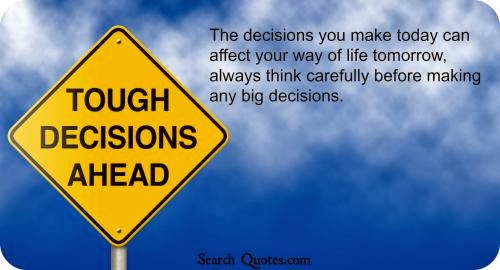
We've all experienced opportunities in which we question the decisions we are about to make or have already made. The dilemma we face is in having faith that we've chosen wisely. Each circumstance we face can lead us in many directions. How do you determine the best option?
Taking that next step, not knowing whether our expectations will be met can be very daunting. If we over think the outcome, the stress builds up and we end up allowing doubt to plague us. There is also fear of the unknown. What happens if we make a choice and it's the wrong choice? Is there an easy fix or are we stuck with the decision we made?
Imagine that you have been presented with two great job opportunities. One job is local, the other job requires moving away from family and friends. You can envision being happy with either career move and you decide to go with whichever opportunity comes available first. Then you begin listening to the opinions of others and you begin to question whether you really weighed all of your options. What then? Do you begin to build yourself up to fear the outcome of your choice? Do you, after making the decision wonder what the outcome would be if you choose a different path? That's a normal reaction.
Then there are times when we've made decisions that we have regretted. We wish for just one more chance to correct what may be viewed as a poor or wrong choice or decision. Maybe it was a decision to purchase a different car, going to a different college or taking a chance on a new relationship. Maybe it was learning something new, making changes or trying something different. After you made your decision, there was a feeling of regret, of wondering what could have been.
Sometimes, you just want to change your mind. You made your decision based on the criteria you previously had on hand. Then new information becomes available and you want one more chance to regroup and make sure that your original decision is still the best option.
The desire to have just one more chance is a normal reaction. It provides us with checks and balances to understand why we made the decisions we made and to make any necessary updates or corrections. Don't be afraid of taking risks, of taking one more chance. Remember, if you take a risk you win and this leads towards happiness. Poor choices may initially be perceived as a loss. You will find, however, that you learn by your mistakes. You begin to make better choices, choices that make you wiser. That's what having just one more chance is all about.
Friday, November 8, 2013
An Addictive Life
Many of us desire different things. At times, these desires turn into cravings. When the cravings become the driving force of our life, then it becomes an addiction.
Addiction is defined as a compulsive need for and use of a habit-forming substance (as nicotine or alcohol) characterized by tolerance & by well-defined physiological symptoms upon withdrawal. Addiction covers a broad spectrum that can include anything from food, relationships, health, money, etc.
How does an addiction begin? One example is that of being under stress. Having stress in our life wreaks havoc on our emotions. When we are dealing with situations that are overwhelming, where we don't see a way out, it's easy to turn to food and or alcohol. For some individuals, food and alcohol serve as a means of a temporary relief from having to cope with unbearable circumstances. It's a means of escaping negativity.
As we continue along the path of wanting to escape from our sorrows, our cravings become rituals. These rituals become habit forming. We rely on the pleasure substance to meet our needs. We then entertain feelings of guilt for attempting to solve our problems via this cycle of addiction.
Addictions can stem from childhood memories, from a sport injury or a car accident. There are also addictions that stem from relationships. Have you ever met or been involved with someone whose addiction was belittling or bullying? Their craving or desire is to cause harm through words. They enjoy trying to make others feel unworthy. These individuals have low self-esteem. Their addiction is to discourage others; to convince them that they have no value. Don't believe their garbage. Throw it out. Learn to trust your insight and what you offer.
Don't allow someone else's addiction to cause you pain. You can offer to lend support to someone who wants to go through recovery. Be encouraging as they go through their trials and tribulations. Don't, however, live in denial with the addict. This is something that parents tend to do. It's hard to see your child suffer. The more you enable someone dealing with addictions the more the situation will remain as is.
If you happen to be the caretaker of an addict (no matter what the addiction) don't forget to take care of yourself. Understand that you can't solve the situation for them. Develop a thick skin and let their tirades roll off of you. Above all, have faith that eventually, the addict will move from living an addictive life into a better life. Now, that's something to look forward to!
Sunday, October 27, 2013
Oops, Did I Do That? (Results of Bad Decisions)
Have you ever purchased items that you couldn't afford (i.e. appliances, clothing, a car or a home, etc,)? Are your credit cards maxed out to the point where payments are a challenge? Do you continue to live your life in a way that keeps you in lack?
At times we all realize that some of the choices we make are not sound. Our decisions can be unwise and the result of being reactionary. The results of our choices leave us wondering, "oops, did I do that"? We may not have thought things through prior to making our decisions.
What steps go into our thought process prior to making choices? Are we in an emotional state, a state of desperation? We purchase things just to have the latest in technology or to have the nicest car. We don't stop to consider whether we can afford the purchase or whether our bank account(s) can support our decision financially. When we are feeling a sense of entitlement, nothing will stop us. Living out of our means doesn't register in our mind. We focus more on and are motivated by the perception of others as to how successful we are.
We often do not realize that the decisions we make can have an impact on our family, friends and even our job. When we are stressed, we tend to blame others, find fault with others including our spouse, children, peers and bosses.
Living in debt wreaks havoc on our emotions, promotes fear (how will we survive?), causes stress and can sometimes lead to making additional poor choices. For example, living from paycheck to paycheck does not allow for opportunities to engage in fun activities such as sports or going to a nice restaurant.
In realizing how poor choices and bad decisions impact your life, there comes a time when you must decide to turn things around. How do you change your spending attitude and or correct any false beliefs you may have related to spending?
It may be helpful to ask the following questions prior to making a purchasing decision:
* Is this something I really need?
* Where will "it" go?
* What is "it" replacing?
* Can I afford "it"?
The answer to these questions will lead you away from an "oops, did I do that?" mentality of living with bad decisions and guide you to making better decisions. The more good decisions you make places you on a path of knowing that your choices are sound and well thought out. You're not making an emotional decision, nor is your decision fear-based.
Making better decisions can be liberating. Isn't that a better way to live?
Monday, October 21, 2013
Oh, Give Me A Break
My goodness. What is up with people who are always complaining that they can't get a break? Life is too hard. They are always a day late and a dollar short. No one likes them. Blah, blah, blah. Seriously??
Life is too short. Every day we are presented with opportunities to better ourselves, to make changes. We can't rely on others to determine how our life will turn out. Sure, people can provide input, offer suggestions and lend an ear, however, ultimately the choice is ours.
Do you find yourself making comparisons to others, feeling a sense of lack when you don't measure up? The path others have chosen may not be a match for you. You can't tailor your life based on the lives of others. There are too many variables that may be unknown to you. Following the stepping-stones of someone else's life could lead you down the wrong path.
Your path is strewn with many bumps in the roads. What lessons have you learned from past mistakes? What lies are taking up space in your mind and heart that aren't true about your self? Release your self from any limitations that are keeping you imprisoned. You've served your time going through the hardships associated with the trials and tribulations. Acknowledging the good in you will set yourself free of the self-imposed bondage.
Maybe it's time to give yourself a pep talk and acknowledge your strengths. Focus on the positive things in your life. When you focus on what is good and right, you bring new life into your "game". You gain a new perspective; you strengthen your character and you operate on "full steam".
Stop expecting others to give you a break. Let go of your ego. Take control of your life. Utilize your inner power source. Continue to "plug in". Focus on where you want to go and plan how you will get there. Then, sit back and enjoy the journey!
Tuesday, October 15, 2013
Liar, Liar, Pants on Fire
Liar, liar, pants on fire is a nursery rhyme taught to children. Every time, a child is caught lying, they face being taunted by playmates singing this little song. Kids have vivid imaginations. They don't necessarily think that they are lying when they stretch the truth.
Do you recall the story of Pinocchio? Every time he told a lie his nose would grow. There are some children who were taught to believe in that fairy tale. Fortunately, they grew out of that false belief.
Have you ever considered why a lie is told or what the outcome is of telling a lie? Typically, people lie to impress others, "white" lies are told by withholding a portion of the truth out of concern that the entire truth could be harmful, people lie to evade issues, and at times, malicious lies are told by "mean-spirited" and oftentimes jealous individuals. There are many more examples of why lies are told.
Lets take a look at some of the outcomes of lying. Lying can cause ruin to one's reputation or character (if the lie is believed). Lying can delay an outcome, however, eventually, the situation will have to be dealt with. A "white lie" is formed out of good intentions, however, when discovered, still causes doubt as to why the need for the lie. "Mean-spirited" individuals sparked by jealousy often spread vicious lies. The ultimate goal is to disparage an individual. Eventually, the "mean-spirited" individual is found out and held to task for their role in the lie.
Other types of lies to consider are the lies we tell ourselves. Lies such as you'll never be successful, you're no good; you're overweight, you're not a good parent, etc. These lies are the most challenging, in that we convince ourselves that the lies are true. We deceive ourselves by holding on to these non-truths. We shame ourselves with the mindset that these negative thoughts originating from both our childhood and adulthood are a permanent fixture. Akin to planting a tree, we water the seeds and watch as the lies grow. Just as the branches of a tree are intertwined, so are the lies embedded in our heart and mind.
The reality is that we don't have to support the lies. We don't have to suffer by living with a victim's mentality. We can change our circumstances. Circumstance is defined as a condition that accompanies or modifies a fact or event, a modifying or influencing factor. It is our choice to either believe the lie and remain stuck or recognize the truth and make some changes.
So, ask yourself, what truths are you willing to acknowledge and focus on? Are you willing to free yourself of the lies or will you continue to play "liar, liar, pants on fire" in your mind? The choice is yours.
Sunday, October 13, 2013
Feeling Angry?
Do you ever wonder what makes you angry?
Anger is described as an intense emotional state induced by displeasure. We have all caused anger and have been at the receiving end of anger. Neither situation is good. When we cause the anger we lay hurt at another persons feet. When we receive anger, it causes a mixture of emotions within us.
We have all faced circumstances that have caused us to react with anger. What is it about certain situations that cause us to adopt a different "personality"? Let me share a few personal examples:
I can recall instances coming home from work yelling at my spouse, kids and even the dog. Every thing they did upset me. I couldn't get a break. There was a consistent barrage of requests. Why couldn't they fend for themselves? I could never turn off the 'open for business" sign of being a wife/mother. What I learned was that the feelings of anger were a result of my being tired. I was able to arrange a 5-minute "me time" as soon as I got home that provided me with a 5-monute respite. The respite worked wonders to alleviate anger caused by stress.
A member of my family is forever angry. The least little thing upsets him. He swears and yells at anyone who does not perform to his demands. It got to the point where I avoided visiting other family members if I knew he would be there. I finally decided I had had enough. I told him that I was setting boundaries. If he wanted a relationship with me, he would have to cease yelling and swearing. He would have to be respectful. I stood my ground and he eventually changed the way he spoke to me.
When I worked in corporate America, I would snap at people who questioned my style of management; how or why I handled things the way I did. I interpreted their questions as "being challenged". I would get upset. I had a need to self-protect. I didn't want anyone to know that I was insecure and afraid of being wrong. I decided to change my approach. Instead of feeling "challenged", I began to ask for their input. This led to the realization that I did not have all the answers, which in turn, enabled me to let go of my insecurities.
These are just a few examples of how to deflect being angry. Think of ways you can turn your anger into learning opportunities. When you are in line at the grocery store and the line is slow, grab a magazine to take your mind off of being impatient. If you are rude to people, if you are a proponent of "road rage", it's time to take a look at why you are experiencing these feelings of anger. What has led up to the situation and what can you do to dissolve the explosive reactions?
We all struggle with ways of handling what life throws our way. Being angry signifies that something in your life needs to be addressed. If you choose to hide from anger and not do anything to correct it, then the anger will eventually control your life. If, however, you come to understand that anger is formed by fear, then you can develop the appropriate tools to diffuse the anger. Remember, anger isn't always a negative. Anger presents you with opportunities to learn different ways of handling situations.
Isn't it time you noticed when these feelings of anger are approaching? Take control of your life. Choose to be happy and stress free when facing challenging times. You'll be glad you did.
Sunday, October 6, 2013
What's Love Got To Do With It?
Love. What a special feeling. Love provides a feeling of comfort. When you know that you are loved, you feel on top of the world. You feel invincible.
There are many types of love. There is love for family, friends, spouse, etc. We begin to experience love at an early age. We grow up appreciating the different types of love. For example, the love you have for family may be different than the love you have for a friend. We begin to understand that those we love and those that love us matter.
When we love we develop a blind faith and trust of those we hold dear to us. We are protective of those we love and we don't want to see our loved ones hurt.
Sometimes, during our "protective" mode, we may feel that our loved one is not making the best decisions in their life. When this happens, we begin to scrutinize and nit-pick their choices. We know what's best; we know what they need.
At times, we may feel the need to remind them of their past failures or mistakes. We forget that we made mistakes. We forget how we felt when someone offered us unsolicited advice or tried to resolve issues for us. We forget the feelings of helplessness. We forget that mistakes and failures teach us the lessons we require to grow. It's through trials and tribulations where we learn to recognize our errors and become secure in trying different options.
It's important that we show our loved ones that they matter to us. Why? What does love have to do with it? Love is the big differentiator. Knowing that no matter how you live your life, no matter what bad choices or decisions you make, you are loved unconditionally. Loving someone means not being judgmental. Loving someone means not having your way.
When we are loved we have a built in "safety net". When we fall, our loved ones are there to catch us by lifting us up with words of encouragement.
What's love got to do with it? Everything!! Enfold yourself in the love that is given to you and watch your heart thrive.
Subscribe to:
Posts (Atom)